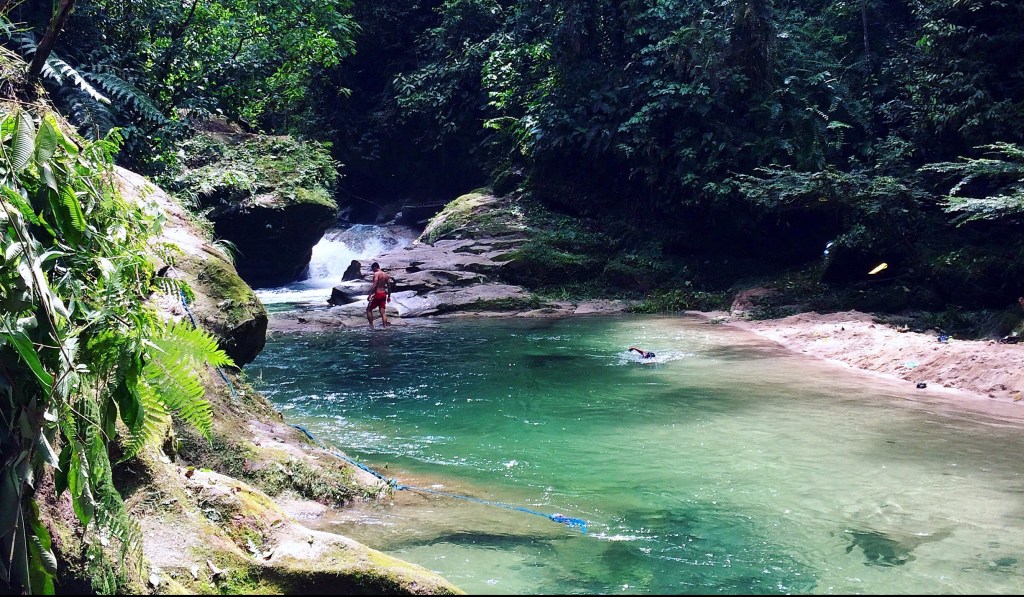
After resting at beautiful Hostal Pakay, we packed up the car and set off to Laguna Azul in Tena. Tena, the capital of the Napo Province, is a city in the Amazon rainforest known as the “cinnamon capital” of Ecuador. The laguna we visited is made up of beautiful natural lagoons, streams, and idyllic rainforest and rocky surroundings. The site is owned by a local community who charge around $3 for tourists and $2 for citizens and residents of Ecuador. There are cobbled paths and bridges leading to the various lagoons, we headed to one and climbed through the rocky surroundings to see the beautiful and clear water, and a still, peaceful and warm air. The surrounding greenery smelt damp and fresh and bonus – there was only us there!


The main lagoon is deep, clear and a great spot for adventurists who like to jump in. The water flows over a waterfall and into the Jatunyacu River or The Upper Rio Napo. Rio Jatunyacu means “big water” in Quichua. The other lagoons we swam in were cold, but the warm, humid air outside made it lovely. The place was great for jumping, swimming, relaxing or simply admiring the jungle scenery. Around the main lagoon are rocks and volcanic boulders from the last big eruption of the Cotopaxi volcano, whose snow-cap feeds the river. Laguna Azul is about half an hour outside of Tena beyond the towns of Pano and Talag. It is a paradise for nature lovers. The area has an amazing biodiversity, with many plants and species endemic to the area. Nature has a wonderful way of soothing and revitalising, of de-cluttering our minds and allowing us to foster appreciation and gratitude while feeling that we too, are a part of it.
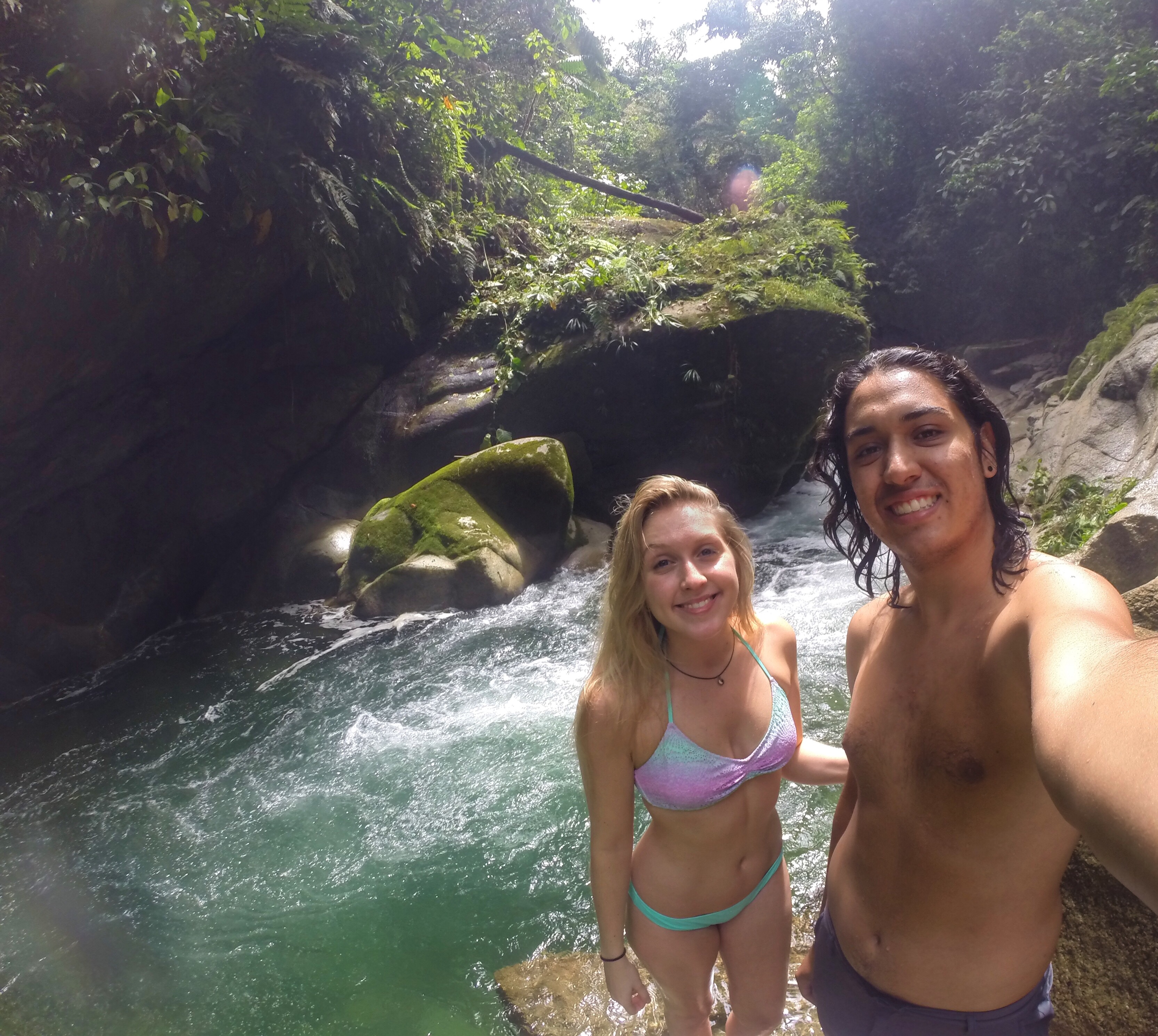
The Ecuadorean government is one of the only governments in the world to give constitutional rights to Nature – Mother Nature, which means people and nature live in harmony, and natural resources are conserved rather than exploited for revenue. The ancient Quechua way of thinking ‘sumak kawasay’, meaning ‘buen vivir’ or ‘good life’, is a rich, connected, mindful way of living harmoniously with ourselves, others and nature. It now permeates through every aspect of Ecuadorean living, and has even become part of Ecuador’s Constitution, which places people over profit and acknowledges the rights of nature. The concept of “Sumak Kawasay” is defined as an “opportunity to build a different society sustained in the coexistence of human beings in harmony nature, based on recognition of the diverse cultural values” (Vanhulst & Beling, 2014) Sumak Kawasay promotes a symbiotic relationship between humans and nature assuming and respecting their differences.
The country continued to mesmerise me throughout my time there with its beautifully natured people, impressive weather changes, amazing food and biodiversity. The ancient teachings of the Indigenous People of Ecuador can flourish and help to transform the modern world; away from commodification, profit and greed and towards growth, co-existence with nature and social, environmental and spiritual wealth.
After having our picnic on a dry, rocky patch, it began to rain, we ran back to the car and quickly got changed under one of the community’s huts by the entrance. There is rainfall year-round, with the heaviest rain in April, May, and June. These quirks of nature left me laughing, and flourishing in a love for nature, exploration, dirt, trees, plants, flowers, leaves, water both still and flowing, animals and discovery. Anyone who has ever stepped foot in woodlands or paddled in fresh water knows that nature is mind-lifting and often mood-boosting. Once we nurture this love for nature, we can begin to cultivate self-love, a love for others and heal and recognise our years of damage to the planet.
We drove away from the city of Tena, which is definitely worth a visit. Lonely Planet praises Tena as “a jungle transport hub; a charming place where many travellers find themselves hanging around quite happily for days before or after a trip into the rainforest. While it won’t win architectural prizes anytime soon, Tena has a friendly population, a gorgeous setting surrounded by jungle-covered hills and lots of backpacker infrastructure. White-water fanatics from around the globe come to paddle and play on the high concentration of surrounding rivers, and the town is home to lots of experienced and highly recommended kayaking operators.”
It was “founded in 1560 and plagued by early indigenous uprisings. Jumandy, chief of the Kichwa (or Quechua), led a fierce but unsuccessful revolt against the Spaniards in 1578. The anniversary of the town’s foundation is celebrated on November 15 with live music and community events.” It’s neighbouring indigenous communities are also centres for numerous volunteers working for reforestation projects, with community support in development initiatives in diverse, and connected areas such as, ecotourism and capacity building.


Mindo, is another small, rainforest town in the Andean foothills of Ecuador. We spent an amazing day there; 100% best day, though slightly terrifying at times. As well as drinking coconut water from a fresh coconut (which might just be my new favourite source of happiness – along with picking an avocado from its tree), we spent the day ziplining (upside down, in superman pose etc.) through the jungle. It was amazing! Then, we went canyoning or abseiling down a waterfall a 90-degree steep drop – it kind of went in on itself. For me, that was the scariest thing. It was very high up with a heavy water flow; I was feeling so much adrenaline, anxiety, panic, excitement. I lost my footing half way, flipped a little and was just hanging in the middle of the jungle above the trees, with the water pounding down. It was scary but amazing, once I made it down I was shaking. I’m so happy I did it, but maybe I’ll wait a while until I do it again. Afterwards we went tubing, which is a bit like rafting, except on homemade DIY rubber rings joined together with rope, down a fast flowing, river. With all the rock obstacles, we got absolutely soaking wet – it was brilliant though. So much laughter! It reminded me of a crazy water park ride, but freezing, or like the river in the Jungle Book!
Look for the bare necessitiesThe simple bare necessitiesForget about your worries and your strifeI mean the bare necessitiesOld Mother Nature’s recipesThat brings the bare necessities of lifeWherever I wander, wherever I roamI couldn’t be fonder of my big homeThe Jungle Book – The Bare Necessities
Despite doing all these mad things with no injuries, I managed to fall over my own feet while taking a photo of street art. Felipe ran into a local store where we got aids for my wounds on my elbow and knee.


The days in La Selva so far have been really fun and a bit wild!
Playlist:
Shakira – Estoy Aqui
Manu Chao – Merry Blues
Maná – Mariposa Tracionera
Resources:
Vanhulst, Julien, and Adrian E. Beling. “Buen Vivir: Emergent Discourse within or beyond Sustainable Development?” Ecological Economics 101 (2014): 54-63.
 Holly Stark
Leave a comment