I write this from the first day of my fast (March 1st); of Lent, a tradition that I have been doing with my family since I can remember. This year I’m giving up meat, chocolates, sweets and biscuits to make up for the last three years I forgot to do it. I really want to feel a sense of achievement, growth and gratitude; like the year I gave up cheese, and the year I gave up sugar in my tea. I’m already feeling better since picking up way more fruits, veggies and herbs than usual. Though Lent is traditionally a Christian season, it is a season of reflection celebrated by many Christians and non-Christians alike. Many people fast for self-discipline, cleansing, accomplishment, renewal, health, moral or other spiritual reasons.
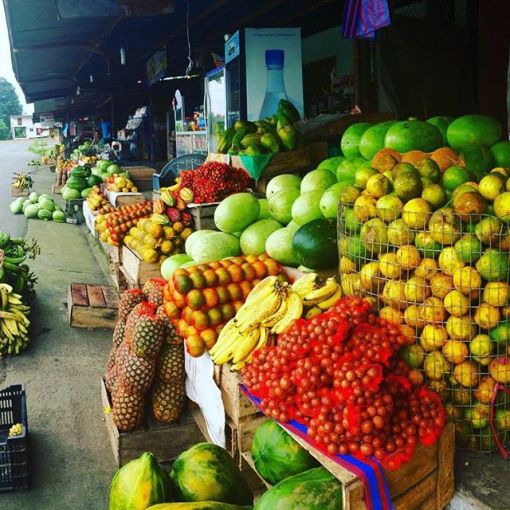
Fruit market on the way to the coast in Ecuador.
Ancient fasting practices were generally inspired by two, often entwined, reasons: special spiritual rites and purification, but motives behind fasting usually vary, depending on the drive to fast. Muslims observe a month of sunrise-to-sunset fasting during Ramadan. Fasting during Ramadan is one of the 5 pillars or grounded beliefs of Islamic faith. During this holy month of Ramadan, the 9th in the Islamic calendar, many Muslims refrain from eating and drinking from dawn to dusk. Though there are exceptions made for those with illness, the elderly, some children, pregnant people and those on their period, others fast and pray peacefully in daylight hours to cultivate a gratitude for food and drink, self-discipline and worship, as for many across the planet, a lack of food and drink is a reality.
Jewish observers may also mark high holidays with fasts, particularly Yom Kippur, the Day of Atonement. On a daily basis, Buddhist monks in Southeast Asia eat their last meal before noon and take no food until the next day. Strict Orthodox observers fast from meat, fish, eggs, dairy products, olive oil, and alcohol every Wednesday and Friday. During Lent, every weekday, they abstain from all those products. For many centuries, Catholics were forbidden from eating meat on all Fridays. Fasting is a part of Hinduism, Buddhism, and many other religious traditions. Spiritual fasting has its roots in mysticism and other practices that have been a part of many Indigenous cultures.
Some people who take part in Lent and fasting don’t actually fast at all, choosing as an alternative to enhance a spiritual practice or prayer. Many consider the 40 days of Lent to be about a whole human experience, including the body. It is also believed that fasting rewires the body to the emotions, mind, and soul, often by disturbing our autopilot mode. It’s detoxification through abstinence or asceticism. For me, it’s about recalibrating, restoring and finding peace, clarity, strength and gratitude from within. In English, Lent got its name from the Old English word len(c)ten, which means “spring season.” People mainly voluntarily give up a vice, lifestyle habit, food, drink or other comfort or adopt a spiritual practice during this time.

Fish ‘n’ Chips from Barton Market Place chippy, England (takeaways like this are often given up at home.)
According to Christian scripture, Jesus spent 40 days and nights fasting in the desert, where he was tempted by Satan. He ate nothing during those days, and at the end of them he was hungry. Lent, for some, mirrors that time in the wilderness by fasting, resisting temptation and complementing activity with prayer or, for others, appreciation and control. As Advent, for Christians, is the season of anticipation leading up to the great feast day of Christmas, Lent is the season that precedes the feast day: Easter, which marks the day when Christians celebrate Jesus’s resurrection. Ash Wednesday, the first day of Lent, falls 46 days before Easter Sunday. The day before Ash Wednesday is often celebrated as Shrove Tuesday, Pancake Day, Fat Tuesday, or Mardi Gras, depending on who you’re talking to. It can involve pancakes, self-reflection or partying (to mark the end of Carnival), depending on where you are in the world. It’s a last wave off before the season of penitence for Christians and patience for non-Christians begins.
After the last few years at university spent neglecting Lent, I decided to take it up again, in a warm embrace, knowing it will “do me some good” as my family would say. I grew up with parents who, on a yearly basis, as February rolls round, give up chocolate, alcohol or other treats and luxury things until Easter Sunday, around April time. They always encourage my sisters and I to do the same. I’m privileged enough to be food secure, so perhaps an abstinence from consuming and indulging is the best way to cultivate a real gratitude and appreciation for the things I have.


My perfect sweet treats from Cocoa Wonderland, Sheffield, England.
I recently read an article “A Town Called Nourish” (Wilton, 2017) for Electric City Magazine which said food-insecurity is a problem in constant need of new, innovative solutions. It noted that around 4 million Canadians identified as food-insecure. Peterborough ranked as the most food-insecure out of 27 urban areas in Ontario, with 1 in 6 households experiencing food insecurity. The number for households with children is 1 in 4.
The Peterborough community have found several answers to this problem. The YWCA and Food Not Bombs (FNB) are two responses working from a community development approach. At the YWCA, the Nourish Project, part of the Peterborough Food Action Network, and a working group of the Poverty Reduction Network say they aim to address “the lack of access to healthy food for individuals and families living on low-incomes; a low and shrinking annual income for local farmers and producers; and an economy that treats food as though it is simply a commodity, and not a basic human right.”
Another grassroots collective, Food Not Bombs (FNB), which is part of a global movement aimed at defending and reclaiming community, sovereignty, and food justice “collects surplus food that would elsewise go to waste from farmers, gardeners, grocers, bulk stores, bakers and kind folk cleaning out their pantries.” They also garden and work to “connect people with skills and opportunities needed to take direct action to empower greater food security”. FNB cook together every week using the materials gathered, providing free food to anyone who is hungry in accessible, public spaces: “FNB is about much more than feeding hungry people; it’s about changing the way communities organize themselves” (Wilton, 2017.) FNB are looking for regular volunteers to take on regular, scheduled roles – Or even if you can do a small roll, it will be mighty.
I’m ready to sacrifice the foods I don’t need, my treat items, especially when thinking of those who are food insecure. Sacrificing meat, chocolate, sweets and biscuits will also contribute towards a healthier life for myself, other beings and the planet. I’ll miss chocolate and hobnobs, but it’s not forever. I’m most looking forward to cutting out meat, maybe that will become permanent. A United Nations report found that eating meat is ‘one of the … most significant contributors to the most serious environmental problems, at every scale from local to global.’ Raising animals for food requires massive amounts of land, food, energy and water; something I will be glad to stop contributing towards. I also will be happy to no longer contribute towards the harming of any beings. I caught up with one of my closest friends Nura Elgamri who questions “If you have the means to not eat meat and be healthy, why not? It’s not an accessible option for everyone and I understand that. My logic is what makes a flamingo, a lion or a eagle any different to any other animal. What makes a cow less?”
I’ll try not to will the time away until the end of Lent (April 13th) because I’m ready to get a balanced diet without eating meat; without subjecting any beings to suffering and death, harming the environment unnecessarily or subjecting my health simply to satisfy a desire, not a need.
My research concludes by looking at pictures of cute animals.


Blog Playlist:
The Stone Roses – I Am The Resurrection
Bob Dylan – The Times They Are A-Changin’
Brandon Flower’s Flamingo
References:
Wilton, C (2017) “A Town Called Nourish”, accessed http://www.electriccitymagazine.ca/2017/01/town-called-nourish/
Food Not Bombs (FNB) http://foodnotbombspeterborough.org/node/7
The Nourish Project http://nourishproject.ca/
http://www.beliefnet.com/Faiths/2001/02/Fasting-Chart.aspx
http://www.un.org/apps/news/story.asp?newsID=20772#.WMLSjfnyvIU
First published for Absynthe Magazine


Leave a comment