After embracing the culture in the Imbabura province of Ecuador, we headed out to see some volcanoes. Continental Ecuador has 28 volcanoes, both active and extinct. While the Galapagos Islands have 15. That’s a total of 43 Ecuadorean volcanoes! I was excited for my first volcanic experience so we woke up at 5am to visit one of the country’s most well-known; Cotopaxi.
It was only a short drive up to Cotopaxi National Park (about 1 hour and a half away from Quito), but we wanted to make the most of the day. Felipe’s Dad is a naturalist, passionate about his country and its diversity, so kindly took us on the trip. We were also joined by Felipe’s lovely 7-year-old sister Violeta. Once we arrived, we hiked around the grassy paramo and explored the surrounding ecological reserve where wild horses ran, ate our picnic and waited for the cloud to reveal the volcano.


It was really chilly up there, so we covered ourselves in layers and woolly hats – and we weren’t even at the top. At 5897 metres (almost 20,000 ft), Cotopaxi has the second highest peak in Ecuador. The first is Chimborazo, which we were also soon to visit. Cotopaxi volcano only cleared fully for about 5 minutes, but it was really beautiful and seemed perfectly conical with red-coloured rock in certain places. Driving out of the park were hundreds of volcanic rocks and boulders from years of explosions, the most recent being August 2015. Prior to this, Cotopaxi had been dormant for over 70 years. This area was El Pegredal and we passed it on our way to our accommodation for the night. We stayed at a hacienda called El Porvenir; a beautiful, red, rustic lodge with thatched roofing, stables and a traditional Andean feel. We were welcomed to the cosy fire place with empanadas de viento, herbal tea and canelazo (hot, sweet and alcoholic) and spent the night relaxing, playing games and admiring the unbelievable landscape. Just before sunset, we rushed outside to see Cotopaxi completely clear and uncovered.


After our stay in a cosy attic room, we awoke to the most amazing view of the volcano. There were no clouds to hide Cotopaxi’s huge and majestic presence. At 9am we went horse riding around the surrounding paramo, with picturesque views of the volcano. We wore traditional ponchos, and samaros (furry trousers) for our ride to keep off the frosty wind. The experience was so thrilling and, as a whole, unlike anything I had done before. I felt so amazed at the beauty of the world and to embrace all things natural with no media or knowledge of anything else going on. All that mattered was the present moment; the impressive mountains and scenery around us. We left after a lunch of yummy Locro Soup (potatoes, cheese, avocado) and got back on the road, heading south west to Quilotoa lagoon crater.


Images of Quilotoa flood my Instagram feed on a frequent basis, popularised by many of the travel pages I follow as one of the most scenic places in South America (and I would argue; the world!) Quilotoa is a lagoon inside a volcanic crater; a “3km water-filled caldera and the most western volcano in the Ecuadorian Andes, formed by the collapse of the dacite volcano following a catastrophic eruption about 800 years ago, which produced currents of hot lava, gas, rock and mudflow that reached the Pacific Ocean, and spread volcanic ash throughout the northern Andes.” The view was absolutely stunning. The rugged rock structure encircled the crystal water which changed colour with the differing light on the laguna. I took about ten photos of the same thing, just with slightly different lighting and colouring, and I can’t bear to delete any of them!
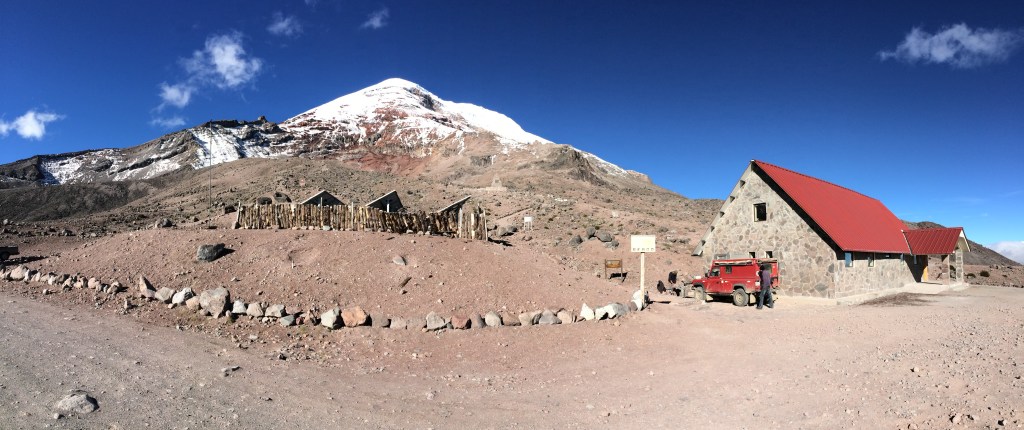
We stayed the night in the city of Riobamba or “Friobamba” as some Ecuadorians refer to it: “frio” meaning cold! Riobamba takes its name for the Spanish word “rio” for river and the Kichua word “bamba” meaning valley. From there we went to Mount Chimborazo, whose summit is the highest point on earth at a colossal 6,310 meters (20,703 feet). “Mount Everest has a higher altitude, and Mauna Kea is “taller.” However, Chimborazo has the distinction of being the “highest mountain above Earth’s center.” This is because Earth is not a sphere – it is an oblate spheroid. As an oblate spheroid, Earth is widest at its equator. Chimborazo is just one degree south of the equator. At that location, it is 6,384 kilometers (3,967 miles) above Earth’s center, or about 2 kilometers (about 1.2 miles) farther from Earth’s center than Mount Everest.” Eating our picnic there was pretty surreal, however I was very out of breath and light-headed – and we were only at the first refugee point. The volcano was completely clear the whole time, and I felt so so lucky to see it. My first volcanic experiences were definitely ones to remember.


Trip Playlist
Cafe Tacuba – Las Flores
Mauricio y Palo de Agua – Niña
Calle 13 – Un Beso de Desayuno
The Killers – Bling (Confessions of a King)


Leave a comment